
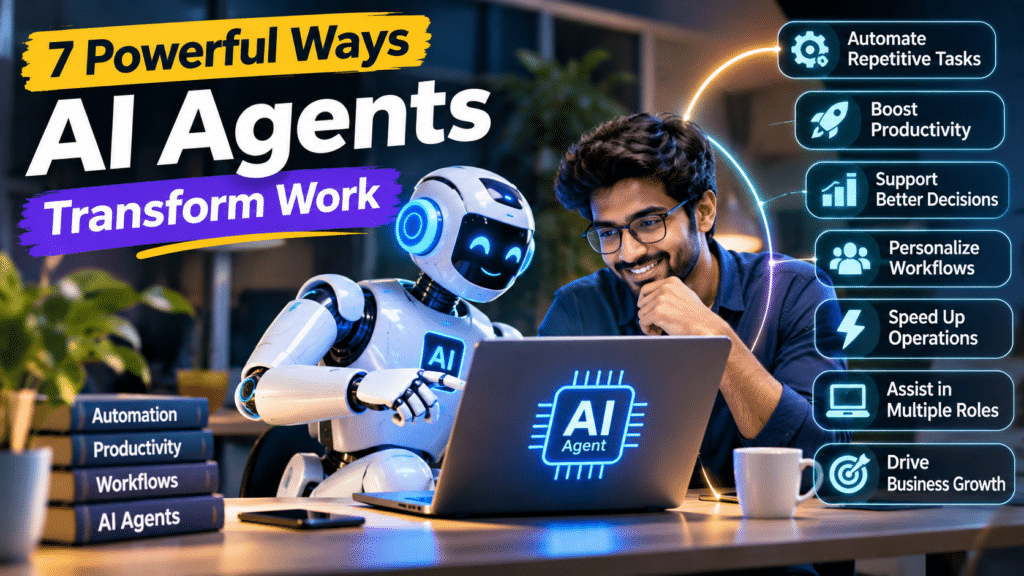
What Are AI Agents? How They Will Change the Way We Work
Introduction
Artificial Intelligence is transforming modern workplaces. Among its latest developments, AI Agents are gaining attention for their ability to automate tasks, make decisions, and improve productivity.
Unlike traditional chatbots, these intelligent systems can understand goals, use digital tools, and perform multiple tasks with limited human intervention.
1. What Are AI Agents?
AI Agents are intelligent software systems that understand instructions, make decisions, and perform actions to achieve specific goals with minimal human assistance.
They use artificial intelligence, reasoning capabilities, memory, and external tools to complete tasks rather than simply providing information.
How Do AI Agents Work?
AI agents follow a structured process to understand instructions and complete assigned tasks.
- Understand: Interpret the user’s instructions and identify the objective.
- Plan: Break complex tasks into smaller steps.
- Execute: Use available tools and applications to perform actions.
- Evaluate: Review the results and identify possible improvements.
- Complete: Deliver the final outcome based on the requested goal.
2. Key Components of AI Agents
AI agents combine several technologies to perform tasks efficiently.
A. Large Language Models (LLMs)
Large Language Models help AI agents understand human language, interpret instructions, and generate meaningful responses.
Examples include GPT, Claude, and Gemini models.
B. Planning and Reasoning
Planning allows AI agents to divide complex objectives into smaller tasks and determine suitable actions.
For example, organizing a business meeting requires checking schedules, identifying available time slots, and preparing invitations.
C. Memory and Context
Memory helps AI agents retain relevant information and use previous interactions to complete tasks more effectively.
It can improve personalization and maintain context throughout multi-step workflows.
D. Tools and Integrations
AI agents can connect with external applications, APIs, databases, and software platforms to perform specific actions.
Examples include email applications, calendars, browsers, and business management systems.
E. Feedback and Evaluation
AI agents can evaluate their actions, identify errors, and determine whether additional steps are necessary.
This process helps improve task completion and reliability.
3. AI Agents vs Traditional Chatbots
Both technologies use artificial intelligence, but their capabilities and purposes are different.
| Feature | Traditional Chatbots | AI Agents |
|---|---|---|
| Main purpose | Answer questions | Complete tasks |
| Decision-making | Mostly predefined | Goal-oriented decisions |
| Tool integration | Usually limited | Multiple integrations |
| Task execution | Mostly conversational | Action-oriented |
| Workflow | Simple interactions | Multi-step processes |
Practical Example
A traditional chatbot explains how to book a flight, while an AI agent can search flights, compare prices, and organize suitable travel options.
4. Real-World Applications of AI Agents
AI agents are finding applications across different industries and business operations.
A. Customer Support
AI agents can understand customer queries, retrieve information, track requests, and assist with resolving common customer problems.
B. Software Development
AI agents can support developers with coding, debugging, documentation, and software testing activities.
They can also assist with generating test cases and identifying potential software defects.
C. Digital Marketing
AI agents can assist marketing professionals with keyword research, competitor analysis, content planning, and campaign performance analysis.
D. Finance and Banking
Financial organizations can use AI agents for transaction monitoring, customer support, financial data analysis, and reporting activities.
E. Human Resources
AI agents can support recruitment activities, interview scheduling, employee queries, and onboarding processes.
5. How AI Agents Will Change the Way We Work
AI agents have the potential to transform traditional workplace processes and improve operational efficiency.
1. Automation of Repetitive Tasks
AI agents can automate repetitive activities such as data entry, report preparation, email management, and appointment scheduling.
2. Increased Productivity
By coordinating multiple workflow steps, AI agents can reduce manual effort and help employees complete tasks more efficiently.
3. Better Decision Support
AI agents can analyze information, identify patterns, and provide insights that support informed business decisions.
4. Personalized Assistance
AI agents can provide personalized support by considering relevant user preferences, instructions, and previous interactions.
5. Faster Business Operations
Businesses can integrate AI agents into existing workflows to reduce delays, streamline processes, and improve operational efficiency.
6. Popular AI Agent Platforms and Tools
Several technology companies are developing platforms and tools that support AI-powered applications and agentic workflows.
A. OpenAI
OpenAI provides AI models and developer tools that can help businesses build intelligent applications and automated agent workflows.
B. Microsoft Copilot
Microsoft Copilot supports productivity, information retrieval, and AI-powered workflows across supported Microsoft applications.
C. Google Gemini
Google Gemini provides AI capabilities for content generation, information processing, reasoning, and application development.
D. Claude
Claude, developed by Anthropic, supports writing, coding, reasoning, and complex information-processing tasks.
E. n8n
n8n is a workflow automation platform that connects applications, APIs, and AI models to create automated workflows.
7. Challenges and Risks of AI Agents
Despite their advantages, AI agents introduce important challenges that organizations must consider before implementation.
A. Data Privacy and Security
AI agents may access sensitive business information and connected applications, making security controls and data protection essential.
B. Incorrect Decisions
AI agents can generate inaccurate information or perform incorrect actions, requiring proper validation and monitoring.
C. Human Oversight
Important decisions involving finance, security, legal matters, and people require appropriate human supervision.
D. Implementation Costs
Building and maintaining AI agent systems may require technical expertise, infrastructure, integrations, and continuous monitoring.
8. Will AI Agents Replace Human Jobs?
AI agents may automate certain tasks, but this does not necessarily mean that all human jobs will disappear.
Instead, many professional roles may evolve as organizations adopt intelligent automation technologies.
Employees who understand AI tools, critical thinking, communication, and problem-solving may gain valuable opportunities.
The future workplace will increasingly involve collaboration between humans and intelligent systems.
9. How to Prepare for the AI Agent Revolution
Learning relevant technical and professional skills can help individuals adapt to changing workplace requirements.
Here are some important skills to consider:
- Learn Artificial Intelligence fundamentals.
- Understand Large Language Models.
- Explore ChatGPT, Claude, and Gemini.
- Learn basic Python programming.
- Understand APIs and integrations.
- Explore workflow automation platforms.
- Develop critical thinking and problem-solving skills.
You do not need to become an AI engineer to start using these technologies effectively.
10. The Future of AI Agents
The future of AI agents will depend on improvements in artificial intelligence, automation, software integrations, and security.
Businesses may increasingly use multiple specialized agents to coordinate customer support, marketing, research, and software development activities.
However, reliability, accountability, privacy, and human supervision will remain important considerations.
Conclusion
AI agents represent an important development in artificial intelligence, moving technology beyond answering questions toward completing real-world tasks.
Their applications across software development, customer support, finance, and digital marketing demonstrate their potential to transform modern workplaces.
As technology evolves, understanding AI Agents and learning to work alongside them will become valuable skills for future professionals.
Frequently Asked Questions (FAQs)
1. What are AI agents in simple terms?
AI agents are software systems that understand instructions, make decisions, use tools, and perform tasks to achieve specific goals.
2. What is the difference between AI and AI agents?
Artificial Intelligence is a broad technology field, while AI agents are systems that use AI capabilities to pursue goals and perform actions.
3. Are ChatGPT and Claude AI agents?
ChatGPT and Claude are AI assistants. When equipped with tools and action-taking capabilities, they can support agentic workflows.
4. Can AI agents work without human intervention?
Some AI agents can perform tasks autonomously within defined permissions, but human supervision remains important for sensitive activities.
5. Do I need programming skills to use AI agents?
Programming is not always necessary. However, Python, APIs, and automation knowledge can help build more advanced AI agent systems.
6. Will AI agents replace software developers?
AI agents can automate parts of software development, but developers remain important for architecture, security, testing, and complex problem-solving.
7. Are AI agents the future of work?
AI agents are expected to play an important role in future workplaces by automating repetitive tasks and supporting business operations.Introduction
Artificial Intelligence is transforming modern workplaces. Among its latest developments, AI Agents are gaining attention for their ability to automate tasks, make decisions, and improve productivity.
Unlike traditional chatbots, these intelligent systems can understand goals, use digital tools, and perform multiple tasks with limited human intervention.
1. What Are AI Agents?
AI Agents are intelligent software systems that understand instructions, make decisions, and perform actions to achieve specific goals with minimal human assistance.
They use artificial intelligence, reasoning capabilities, memory, and external tools to complete tasks rather than simply providing information.
How Do AI Agents Work?
AI agents follow a structured process to understand instructions and complete assigned tasks.
- Understand: Interpret the user’s instructions and identify the objective.
- Plan: Break complex tasks into smaller steps.
- Execute: Use available tools and applications to perform actions.
- Evaluate: Review the results and identify possible improvements.
- Complete: Deliver the final outcome based on the requested goal.
2. Key Components of AI Agents
AI agents combine several technologies to perform tasks efficiently.
A. Large Language Models (LLMs)
Large Language Models help AI agents understand human language, interpret instructions, and generate meaningful responses.
Examples include GPT, Claude, and Gemini models.
B. Planning and Reasoning
Planning allows AI agents to divide complex objectives into smaller tasks and determine suitable actions.
For example, organizing a business meeting requires checking schedules, identifying available time slots, and preparing invitations.
C. Memory and Context
Memory helps AI agents retain relevant information and use previous interactions to complete tasks more effectively.
It can improve personalization and maintain context throughout multi-step workflows.
D. Tools and Integrations
AI agents can connect with external applications, APIs, databases, and software platforms to perform specific actions.
Examples include email applications, calendars, browsers, and business management systems.
E. Feedback and Evaluation
AI agents can evaluate their actions, identify errors, and determine whether additional steps are necessary.
This process helps improve task completion and reliability.
3. AI Agents vs Traditional Chatbots
Both technologies use artificial intelligence, but their capabilities and purposes are different.
| Feature | Traditional Chatbots | AI Agents |
|---|---|---|
| Main purpose | Answer questions | Complete tasks |
| Decision-making | Mostly predefined | Goal-oriented decisions |
| Tool integration | Usually limited | Multiple integrations |
| Task execution | Mostly conversational | Action-oriented |
| Workflow | Simple interactions | Multi-step processes |
Practical Example
A traditional chatbot explains how to book a flight, while an AI agent can search flights, compare prices, and organize suitable travel options.
4. Real-World Applications of AI Agents
AI agents are finding applications across different industries and business operations.
A. Customer Support
AI agents can understand customer queries, retrieve information, track requests, and assist with resolving common customer problems.
B. Software Development
AI agents can support developers with coding, debugging, documentation, and software testing activities.
They can also assist with generating test cases and identifying potential software defects.
C. Digital Marketing
AI agents can assist marketing professionals with keyword research, competitor analysis, content planning, and campaign performance analysis.
D. Finance and Banking
Financial organizations can use AI agents for transaction monitoring, customer support, financial data analysis, and reporting activities.
E. Human Resources
AI agents can support recruitment activities, interview scheduling, employee queries, and onboarding processes.
5. How AI Agents Will Change the Way We Work
AI agents have the potential to transform traditional workplace processes and improve operational efficiency.
1. Automation of Repetitive Tasks
AI agents can automate repetitive activities such as data entry, report preparation, email management, and appointment scheduling.
2. Increased Productivity
By coordinating multiple workflow steps, AI agents can reduce manual effort and help employees complete tasks more efficiently.
3. Better Decision Support
AI agents can analyze information, identify patterns, and provide insights that support informed business decisions.
4. Personalized Assistance
AI agents can provide personalized support by considering relevant user preferences, instructions, and previous interactions.
5. Faster Business Operations
Businesses can integrate AI agents into existing workflows to reduce delays, streamline processes, and improve operational efficiency.
6. Popular AI Agent Platforms and Tools
Several technology companies are developing platforms and tools that support AI-powered applications and agentic workflows.
A. OpenAI
OpenAI provides AI models and developer tools that can help businesses build intelligent applications and automated agent workflows.
B. Microsoft Copilot
Microsoft Copilot supports productivity, information retrieval, and AI-powered workflows across supported Microsoft applications.
C. Google Gemini
Google Gemini provides AI capabilities for content generation, information processing, reasoning, and application development.
D. Claude
Claude, developed by Anthropic, supports writing, coding, reasoning, and complex information-processing tasks.
E. n8n
n8n is a workflow automation platform that connects applications, APIs, and AI models to create automated workflows.
7. Challenges and Risks of AI Agents
Despite their advantages, AI agents introduce important challenges that organizations must consider before implementation.
A. Data Privacy and Security
AI agents may access sensitive business information and connected applications, making security controls and data protection essential.
B. Incorrect Decisions
AI agents can generate inaccurate information or perform incorrect actions, requiring proper validation and monitoring.
C. Human Oversight
Important decisions involving finance, security, legal matters, and people require appropriate human supervision.
D. Implementation Costs
Building and maintaining AI agent systems may require technical expertise, infrastructure, integrations, and continuous monitoring.
8. Will AI Agents Replace Human Jobs?
AI agents may automate certain tasks, but this does not necessarily mean that all human jobs will disappear.
Instead, many professional roles may evolve as organizations adopt intelligent automation technologies.
Employees who understand AI tools, critical thinking, communication, and problem-solving may gain valuable opportunities.
The future workplace will increasingly involve collaboration between humans and intelligent systems.
9. How to Prepare for the AI Agent Revolution
Learning relevant technical and professional skills can help individuals adapt to changing workplace requirements.
Here are some important skills to consider:
- Learn Artificial Intelligence fundamentals.
- Understand Large Language Models.
- Explore ChatGPT, Claude, and Gemini.
- Learn basic Python programming.
- Understand APIs and integrations.
- Explore workflow automation platforms.
- Develop critical thinking and problem-solving skills.
You do not need to become an AI engineer to start using these technologies effectively.
10. The Future of AI Agents
The future of AI agents will depend on improvements in artificial intelligence, automation, software integrations, and security.
Businesses may increasingly use multiple specialized agents to coordinate customer support, marketing, research, and software development activities.
However, reliability, accountability, privacy, and human supervision will remain important considerations.
Conclusion
AI agents represent an important development in artificial intelligence, moving technology beyond answering questions toward completing real-world tasks.
Their applications across software development, customer support, finance, and digital marketing demonstrate their potential to transform modern workplaces.
As technology evolves, understanding AI Agents and learning to work alongside them will become valuable skills for future professionals.
Frequently Asked Questions (FAQs)
1. What are AI agents in simple terms?
AI agents are software systems that understand instructions, make decisions, use tools, and perform tasks to achieve specific goals.
2. What is the difference between AI and AI agents?
Artificial Intelligence is a broad technology field, while AI agents are systems that use AI capabilities to pursue goals and perform actions.
3. Are ChatGPT and Claude AI agents?
ChatGPT and Claude are AI assistants. When equipped with tools and action-taking capabilities, they can support agentic workflows.
4. Can AI agents work without human intervention?
Some AI agents can perform tasks autonomously within defined permissions, but human supervision remains important for sensitive activities.
5. Do I need programming skills to use AI agents?
Programming is not always necessary. However, Python, APIs, and automation knowledge can help build more advanced AI agent systems.
Keep reading
Insights
Jensen Huang Nvidia CEO Returns: 5 Stunning Facts
Introduction Jensen Huang Nvidia CEO news shocked everyone: in two weeks, the co-founder stepped down, was told he would not return, and then came back. On November 23,…
Insights
Jensen Huang Resigns as Nvidia CEO (2026): Full Timeline
Introduction On November 12, 2026, the tech world woke up to news that very few people saw coming: Jensen Huang had resigned as CEO of Nvidia. For 33…