
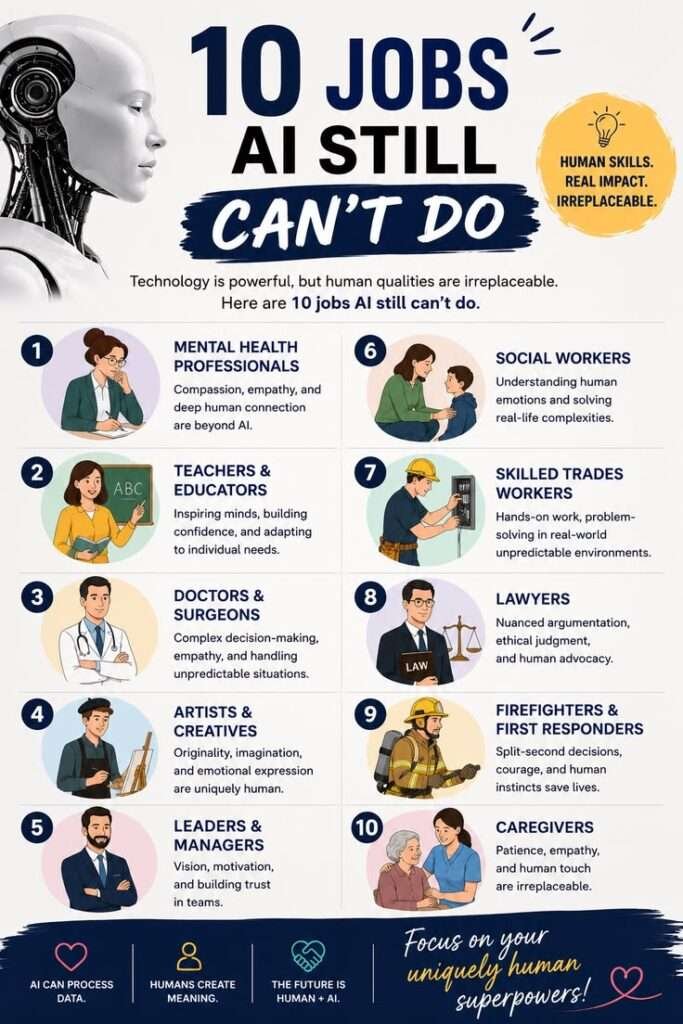
Every few months, a new AI tool arrives and the same fear returns: will my job survive? The truth about jobs AI can never replace is far more hopeful than most headlines suggest.
Sridhar Vembu, the co-founder of Zoho, has spent years arguing that technology should serve people and villages, not push them aside. His view on the future of AI is calm, practical, and rooted in real work.
In this article, we look at three sectors that stay deeply human: agriculture, medicine, and education, why they matter, and how you can prepare for the AI era without panic.
In this guide, you will learn:
- What jobs AI can never replace, in simple words
- What Sridhar Vembu has said about AI and work
- Why agriculture, medicine, and education stay human
- How to prepare your career for the AI era
What Are Jobs AI Can Never Replace?
Jobs AI can never replace are roles that depend on physical presence, human trust, emotional understanding, or real-world judgment. Software can assist with them, but it cannot fully copy the person doing the work.
Think about what AI does best. It reads huge amounts of data, finds patterns, writes drafts, and answers questions quickly. All of this happens inside a screen, which is exactly where its strength ends.
A machine cannot sit with a worried parent, judge the mood of a field after rain, or feel when a wooden joint is slightly off. Those moments need a human being.
That is why the safest careers are not always the most glamorous ones. They are the ones where people value the human touch, and where mistakes in the real world carry real consequences.
Who Is Sridhar Vembu, and Why Does His View Matter?
Sridhar Vembu is the co-founder and Chief Scientist of Zoho, an Indian software company that builds its products from small towns instead of crowded metros, and competes with global giants.
Unlike many technology leaders, he often speaks about villages, farming, skills, and local jobs. He believes a country grows strong when ordinary people can earn a good living close to home.
He also practises what he says. Zoho hires and trains young people through its own learning programme, giving more importance to skill and curiosity than to expensive degrees.
When a software founder says that some jobs will stay human, the message carries weight. He is not an outsider criticising AI; he builds technology every single day.
What Does It Mean When AI Replaces Jobs?
When people say AI will replace jobs, they mean software that performs tasks once done by humans, often faster and cheaper. It usually replaces tasks first, and only later entire roles.
The jobs at greatest risk are repetitive and screen-based: basic data entry, simple report writing, routine customer replies, and similar work that follows fixed rules and needs little personal judgment.
But replacement is rarely total. In many offices, AI removes the boring part of a job and leaves the human with more thinking, more talking, and more responsibility.
So the real question is not whether AI is powerful. The real question is which work needs something a machine does not have, and that brings us to the three safest areas.
What Did Sridhar Vembu Say About AI and Jobs?
Sridhar Vembu says AI will bring many changes and play a major role in national growth, yet agriculture, medicine, and education will never face harm from it, as reported by Payanam.india on 14 November 2026.
This is a hopeful message. He does not deny that AI is powerful; he simply points to three sectors built on land, health, and learning, which every society needs.
Let us look at each of these three jobs AI can never replace, and understand why they stay strong in the years ahead.
What Vembu has said about AI and enduring work:
- He describes four lasting pillars of human work: nature, nurture, culture, and scripture, covering agriculture, education, and healthcare, sport, and religious life.
- He does not expect AI to make entire professions obsolete, pointing to human judgment and accountability in medicine, law, and software architecture, as PTI reported.
- His bigger worry is skill loss among young workers who depend too much on AI, and he has voiced concern about software engineering jobs.
- Earlier this year, he also said that caring for children, teaching, caring for the elderly, and returning to farming would remain unaffected by AI.
Job 1: Agriculture, One of the Jobs AI Can Never Replace
Agriculture is the science and practice of growing crops and raising animals to produce food, and it depends on soil, weather, water, and the daily judgment of the farmer.
Vembu has long spoken about the importance of farming and rural life. Food is the one need that never disappears, and a nation that forgets its farmers quietly weakens itself.
AI can certainly help here. Sensors, weather forecasts, and drone images can guide when to water or spray, reducing waste and improving yields for farmers who choose to use them.
Yet a field is not a spreadsheet. Every plot has its own soil, every season behaves differently, and a good farmer reads small signs that no dataset fully captures.
Technology becomes a helpful tool in the farmer’s hands. It will not walk the land at dawn, make a hard call about a failing crop, or carry generations of experience.
If you are young and curious, modern agriculture, food processing, and agri-technology offer a strong future, because they combine human knowledge with smart tools and steady demand.
Why agriculture stays human:
- Every farm has different soil, water, and weather
- Farmers make daily judgment calls that data alone cannot make
- Food is a need that never goes away
- AI works best as a helper tool, not a replacement
Job 2: Medicine, a Field of Jobs AI Can Never Replace
Medicine is the field of diagnosing, treating, and caring for patients, covering doctors, nurses, pharmacists, and technicians who protect human health and take responsibility for every decision they make.
Think about the last time you were seriously ill. You wanted more than information; you wanted a doctor who listened, examined you carefully, and took responsibility for your treatment.
AI can read scans, summarise reports, and flag risks in seconds. That is valuable, and many hospitals already use such tools to support doctors, not to replace them.
But a patient is not a data point. Medicine needs judgment in unclear situations, and someone accountable when a decision affects a human life.
Nurses, surgeons, and caregivers also work with their hands and their presence. A frightened patient wants a calm voice and a gentle touch, not a perfectly worded paragraph.
As AI takes over paperwork and routine checks, medical professionals may gain more time for what matters most: listening, healing, and caring for people.
For students, careers in medicine, nursing, pharmacy, and allied health remain strong choices, especially for those who combine medical skill with comfort in using digital tools.
Why medicine stays human:
- Doctors carry responsibility for life-and-death decisions
- Patients need trust, empathy, and a human touch
- AI can support diagnosis and screening, but the WHO guidance on AI for health says ethics and human rights must stay at the centre
- Nursing and surgery depend on skilled hands and real presence
Job 3: Education, a Sector of Jobs AI Can Never Replace
Education is the process of helping people gain knowledge, skills, and values through teachers, mentors, and schools that guide students far beyond simple facts and answers.
AI can explain a lesson at midnight and answer doubts instantly. Many students already use it as a study partner, and that can be a real advantage.
But a child needs more than information. A child needs encouragement, patience, and an adult who notices when something is wrong, even when nothing has been said aloud.
Good teachers also shape character. They inspire, correct, and believe in students before the students believe in themselves, and that kind of influence cannot be downloaded.
Vembu has often stressed learning by doing and building real skills. A mentor who guides that journey gives a student something no app can offer: personal attention.
Teachers who use AI to prepare lessons and check homework will save time, then spend it on the human side of teaching, where it matters most.
Why education stays human:
- Teachers inspire, motivate, and build character
- Students need personal attention, not just quick answers
- UNESCO’s guidance urges a human-centred approach and warns that over-dependence on AI can weaken human agency, as this World Economic Forum summary explains
- Vembu himself worries that students who lean too much on AI may not build deep skills
How to Prepare for the AI Era
Preparing for the AI era means building skills that stay valuable when technology improves, while learning to use AI tools so they work for you rather than against you.
First, learn the basics of AI. You do not need to code. Simply practise using tools for research, planning, and drafting, so you become faster than someone who ignores them.
Second, build a real skill. Whether it is farming, medicine, or education, deep practical ability gives you an edge that a general-purpose tool cannot easily match.
Third, grow your human strengths. Communication, empathy, honesty, and problem solving become more valuable when machines handle the routine work, and employers notice people who have them.
Finally, stay curious. The people who struggle with change are usually those who stop learning, while those who keep adapting find new opportunities where others see only risk.
Your quick AI-proof career checklist:
- Learn basic AI tools for research and planning
- Build one deep, practical skill
- Strengthen communication and empathy
- Keep learning every year
Common Myths About AI and Jobs
A common myth is that AI will take every job within a few years. History shows that new technology changes work gradually, removes some roles, and creates many new ones.
Another myth is that only low-paid jobs are at risk. In reality, some office tasks that look prestigious are easier for AI to copy than a farmer’s or a nurse’s daily work.
A third myth says that learning AI means losing your human value. The opposite is true, because people who combine human judgment with smart tools will usually outperform those who rely on either one alone.
Key Takeaways: Jobs AI Can Never Replace
- Agriculture, medicine, and education depend on human judgment, trust, and presence
- Sridhar Vembu says AI will change many things, but not these core sectors
- AI is a helper tool, not a substitute for human skill
- The best career plan is deep skill plus smart use of AI
Conclusion: The Future Still Needs People
The fear around AI is understandable, but it should not push you toward panic. The jobs AI can never replace share one thing: they depend on real human skill, trust, and presence.
Sridhar Vembu’s message is simple. Respect the land, respect the healers, and respect the teachers who shape the next generation. These are the foundations of a healthy society.
So if you are choosing a career, do not ask only what AI can do. Ask where people will always need people, then build real skill there and let AI help you along the way.
The future of work will be shaped by technology, but it will still be led by humans. Keep learning, stay adaptable, and remember that jobs AI can never replace are built on what makes us human.
Further Reading on AI and Jobs
- AI doom fears overstated, global pause unrealistic: Zoho’s Sridhar Vembu (Business Standard)
- Sridhar Vembu says AI doom fears overstated (Daily Pioneer, PTI)
- Zoho founder Sridhar Vembu lists activities that will be unaffected by AI (Inshorts)
- Ethics and governance of artificial intelligence for health (WHO)
- Generative AI and education: UNESCO guidance explained (World Economic Forum)
- UNESCO calls for regulations on AI use in schools (UN News)
Keep reading
Insights
Kalyan Krishnamurthy Steps Down After 11 Years: Big Shock
The news that Flipkart CEO Kalyan Krishnamurthy steps down after more than 11 years has surprised India's business world. Here is what happened, why it matters, and what…
Insights
Top 10 High-Income Skills to Learn in 2027
Introduction The job market is changing rapidly. Artificial Intelligence, automation, and digital technologies are creating new career opportunities. Learning the right high-income skills can help you improve your…