
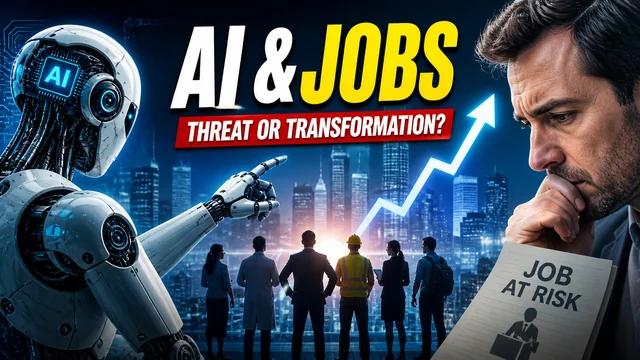
Will AI replace my job completely?
In most cases, no. AI replaces repetitive tasks, not skilled people. Jobs that need judgment and human trust will stay valuable.
Which jobs are most at risk from AI?
Jobs with repetitive work, such as data entry, basic support, and routine documentation. People in these roles can stay safe by learning AI tools.
What AI skills should a fresher learn first?
Start with AI tools and prompt writing. Then add Excel, SQL, or Power BI.
How long does it take to learn AI skills?
With daily practice, you can see results in 30 days.
Do I need coding to work with AI?
No. Tools like ChatGPT, Claude, and Copilot work with simple language.
Introduction
Will AI replace your job? This question is on almost everyone’s mind today. You see it in the news, on LinkedIn, and in office conversations. Freshers worry, “Will I even get a job?” Experienced professionals worry, “Will my role still exist in five years?”
The good news is that AI is not going to replace every job. But people who know how to use AI will move ahead of people who don’t. So instead of being afraid, it is smarter to get ready.
AI jobs are growing fast, and the people who learn AI skills early will get the best opportunities.
In this blog, you will learn:
- What AI means, in simple words
- Which jobs are at higher risk and which are safer
- 7 important skills to learn right now
- A simple 30-day plan to get started
Artificial Intelligence (AI)
Definition: Artificial Intelligence is the ability of a computer system to perform tasks that normally need human intelligence, such as learning, understanding language, and making decisions.
In simple words, AI is a computer that can learn from information and then answer questions or solve problems. When you ask ChatGPT or Claude a question and get a useful reply, that is AI at work.
What AI can do today:
- Write emails, reports, and summaries
- Analyze large amounts of data in seconds
- Create images, videos, and code
- Answer customer questions 24/7
Generative AI
Definition: Generative AI is a type of artificial intelligence that can create new content such as text, images, code, audio, and video based on the instructions given by the user.
Tools like ChatGPT, Claude, Gemini, and Microsoft Copilot are all generative AI tools. They are changing how office work gets done.
Why people use it:
- It saves a lot of time
- It gives a quick first draft
- It helps generate new ideas
- It is easy for beginners to use
AI Automation
Definition: AI automation is the use of artificial intelligence to perform repetitive tasks automatically without human effort.
This is the main reason people worry about their jobs. If a task is the same every day, AI can learn to do it quickly.
Tasks with higher automation risk:
- Data entry
- Basic report preparation
- Simple customer support
- Routine formatting and documentation
- Basic testing and checking
Tasks with lower automation risk:
- Leading a team and making decisions
- Managing client relationships
- Strategy and planning
- Creative problem solving
- Work that needs human trust and empathy
Key point: AI replaces tasks more than it replaces entire jobs. The repetitive parts of your job are at risk, but the thinking, judgment, and people parts stay valuable.
Will AI Replace Your Job? The Honest Answer
Here is the straight answer: some jobs will change, some tasks will disappear, and many new jobs will be created.
The same fear existed when computers first arrived. Typewriter jobs faded away, but IT, data, and digital marketing careers were born. AI is following the same pattern.
New AI Jobs Being Created Today
- AI Prompt Engineer
- AI Automation Specialist
- Data Analyst
- AI Product Manager
- AI Trainer and Reviewer
- SAP + AI Consultant
7 Skills to Learn Before It’s Too Late
1. AI Tools Knowledge
If you are worried about whether AI will replace your job, these seven skills will keep you ahead.
Definition: AI tools knowledge is the ability to use AI-based applications effectively to complete work faster and better.
This is the easiest first step. Start using one AI tool in your daily work.
How to start:
- Use ChatGPT or Claude to draft emails
- Use AI to summarize meeting notes
- Ask Copilot to help with Excel formulas
- Ask AI to explain a new topic in simple words
2. Prompt Engineering
Definition: Prompt engineering is the skill of writing clear and effective instructions to get accurate and useful responses from an AI model.
Two people can ask the same AI tool a question and get very different answers. A better prompt gives a better result.
A good prompt includes:
- Role: “You are a senior HR manager.”
- Task: “Write a job description.”
- Context: “It is for a fresher SAP consultant.”
- Format: “Give the answer in 5 bullet points.”
Tip: Give all the details in one prompt. The more clear you are, the better the output.
3. Data Literacy
Definition: Data literacy is the ability to read, understand, analyze, and communicate using data.
AI can analyze data, but you must know which question to ask and whether the answer is correct.
Skills and tools to learn:
- Excel: Formulas, pivot tables, XLOOKUP
- SQL: Pulling data from databases
- Power BI: Building dashboards and reports
- Basic statistics: Average, trends, percentages
Data skills are useful in every industry, so they keep your career options open.
4. Domain Knowledge
Definition: Domain knowledge is deep expertise in a specific field or industry, such as finance, HR, supply chain, or healthcare.
AI is a general tool. It does not have your real-world experience.
Examples:
- An SAP FICO consultant must understand accounting rules
- An HR professional must understand labor laws and employee behavior
- A supply chain professional must understand real delays and risks
Simple formula: Domain Knowledge + AI = Powerful Career
5. Automation Skills
Definition: Automation skills are the ability to build simple systems or workflows that complete repetitive tasks automatically.
If you can automate boring tasks, you become far more valuable to your company.
Beginner-friendly tools:
- Excel Macros
- Power Automate
- Basic Python scripts
- Zapier and other no-code tools
Benefit: You save time and can spend it on higher-value work.
6. Soft Skills
Definition: Soft skills are personal abilities such as communication, teamwork, leadership, and emotional intelligence that help people work well with others.
AI has no feelings, no real relationships, and no human trust. That is where people win.
Soft skills that matter most:
- Clear speaking and writing
- Teamwork
- Problem solving
- Negotiation
- Storytelling, which means explaining data like a story
Technical skills plus soft skills is the combination that gets promotions.
7. Continuous Learning (Upskilling)
Definition: Upskilling is the process of learning new skills to stay relevant and improve career growth as technology changes.
Tools keep changing. The tool that is trending today may be outdated in six months. So the habit of learning matters more than any single tool.
Easy learning habits:
- Learn for 30 minutes daily
- Try one new AI feature every week
- Build one mini project every month
- Share what you learn on LinkedIn
Future of Work: What Will 2027 Look Like?
Definition: The future of work refers to how jobs, skills, and workplaces are changing due to technology, automation, and new ways of working.
c) “Future of Work” section-la add pannunga:
In the future of work, the question is not only “will AI replace your job,” but “will you be ready for it?”
What you can expect:
- Most companies will use AI tools in daily work
- Job descriptions will ask for “AI skills”
- Small teams will deliver more work with AI support
- Companies will hire based on skills, not just degrees
You don’t need to wait. Here is a simple plan to protect your career, even if AI changes your job.
30-Day Action Plan
| Week | What to Do |
|---|---|
| Week 1 | Use one AI tool daily (ChatGPT, Claude, or Copilot) |
| Week 2 | Write prompts for 10 real work tasks |
| Week 3 | Start learning Excel, Power BI, or SQL basics |
| Week 4 | Build a mini project and share it on LinkedIn |
Common Mistakes to Avoid
- Don’t avoid AI out of fear
- Don’t use AI answers without checking them
- Don’t depend on just one tool
- Don’t keep postponing learning to “tomorrow”
- Don’t focus only on technical skills and ignore soft skills
Conclusion
So, will AI replace your job? The real answer is that AI will replace repetitive tasks, not skilled people. Those who learn to work with AI will be the most valuable in the years ahead.
Ultimately, the answer to whether will AI replace your job comes down to how quickly you adapt to these new technologies. Asking will AI replace your job is natural, but shifting your focus toward upskilling is the best way to secure your career. Instead of stressing over will AI replace your job, start integrating basic automation tools into your daily routine today. Professionals who proactive address the concern of will AI replace your job by mastering prompt engineering and data skills will remain indispensable. So, stop wondering will AI replace your job and take charge of your future; because while the question of will AI replace your job will continue to trend, prepared professionals will always thrive.
So, will AI replace your job completely? The reality is that asking “will AI replace your job” misses the bigger picture, as technology transforms how we work rather than simply eliminating roles. Instead of worrying if will AI replace your job tomorrow, focus on mastering modern tools that enhance your daily productivity. Knowing whether will AI replace your job depends largely on your willingness to adapt, upskill, and learn prompt engineering. Ultimately, asking “will AI replace your job” should motivate you to embrace these tools today so that the answer to “will AI replace your job” remains a confident no.
For deeper insight into how automation impacts global employment, read the World Economic Forum’s Future of Jobs Report.
Keep reading

Insights
Will AI Take Jobs in Tamil Nadu? Reality Check 2026
Introduction “AI is here. Will I lose my job?”. If you live in Tamil Nadu, you have probably asked this question, or heard someone around you ask it.…
Insights
Python for AI and Machine Learning: A Beginner’s Guide
Introduction Python for AI and machine learning now power everything from Netflix recommendations to medical diagnosis. If you want to work in this field, the first question is…